Pursuant to the General Data Protection Regulation (“GDPR”) of European Union, we are committed to protect your data and put you in control. We have updated and will periodically update our Privacy Notice in line with GDPR. See our latest version of the Privacy Notice.
This site uses cookies to offer you a better browsing experience. Find out more on how we use cookies here.


Sustainable Environment

Environmental Policy
Against the backdrop of increasing climate change risks and tightening sustainability requirements, corporate environmental management has gradually evolved from voluntary management to compliance with international regulations and broader supply chain expectations. With the implementation of the EU Corporate Sustainability Reporting Directive (CSRD), companies are required not only to strengthen management of climate change, resource use, and pollution prevention, but also to extend such requirements across the supply chain to enhance transparency and consistency of sustainability disclosures. For export-oriented industries, compliance with international environmental regulations and customer sustainability expectations has become a key factor in maintaining market competitiveness.
In response to these trends, the Company continues to promote carbon reduction initiatives, improve energy efficiency, and strengthen resource circularity practices. At the same time, the Company is progressively enhancing its management systems and implementation effectiveness for key environmental issues, including climate change response, water resource management, waste reduction, and air pollution control, in order to systematically reduce environmental impacts from operations.
Guided by the core philosophy of “Environmental Protection and Sustainable Regeneration,” Getac has established its environmental policy in accordance with the Sustainable Development Best Practice Principles. All operating sites are required to comply with local environmental regulations and implement measures related to energy conservation, carbon reduction, resource management, and hazardous substance control. In response to the global energy transition, renewable energy has been incorporated into the Company’s decarbonization strategy, with gradual adoption beginning in 2025 to reduce reliance on fossil fuels and enhance energy resilience and sustainability. Through systematic environmental management and continuous improvement initiatives, the Company is committed to building a low-carbon, energy-efficient, and responsible operating model, while collaborating with customers and supply chain partners to promote a sustainable value chain and fulfill its long-term commitment to environmental protection and sustainable development.
ISO 14001 Environmental Management System (100% Coverage)
All operating sites have implemented the ISO 14001 Environmental Management System and obtained third-party certification, with full coverage included within the scope of this report. Through a systematic management approach, the Company continuously conducts environmental risk identification, regulatory compliance assessments, and target management, while ensuring effective implementation through internal audits and external verification. Going forward, the Company will continue to strengthen the execution and coverage of its environmental management system to further enhance overall environmental governance and sustainability performance.
| Getac Environmental Policy | |
| 1 | Compliance with Laws and Regulations and Risk Prevention Actively pay attention to global climate change trends, assess related risks and opportunities, conduct management and prevention in advance to grasp the development of laws and regulations, and ensure that operations comply with domestic and foreign environmental laws and regulations, such as EU RoHS, WEEE, and REACH; uphold the principle of clean production and strictly implement product and environmental management, build a green product platform and organize green supply chain management to meet customer requirements. |
| 2 | Energy Conservation, Carbon Reduction, and Circular Innovation Invest in effective energy- and water-saving initiatives to maximize resource efficiency; reduce carbon emissions through green manufacturing processes and innovative technologies; continuously improve waste and pollution management performance to minimize emissions and waste throughout the production process, while advancing sustainable development and promoting resource circularity. |
| 3 | Green Products, Environmentally Friendly Advance the environmental protection design of products, restrict the use of toxic and hazardous substances, and select environmentally friendly materials, such as plastic cases that comply with EU RoHS and are free of brominated flame retardants. The energy consumption design of the product conforms to the requirements of international energy labels, such as Energy Star, and achieves lightweight packaging, minimized material types, and optimized volume. Under the premise of meeting customer requirements, encourage the use of recycled raw materials and environmentally friendly materials, and reduce the use of packaging materials to reduce environmental impact. |
| 4 | Information Transparency, Communication Initiative Establish communication and consultation channels, disclose information related to environment, and communicate environmental policies with stakeholders. Proactively advocate and publicize sustainable issues, raise the environmental awareness of stakeholders, and leverage corporate influence to jointly promote environmental protection. |
| 5 | Continuous Improvement, Effective Management The Company establishes environmental objectives through its Environmental Management System (EMS), conducts regular reviews, and integrates environmental management into daily operations by providing appropriate communication, awareness program and training, thereby continuously improving environmental management performance. |
Circular Economy
Getac is committed to integrating circular economy principles into product design and operational management. Through improved resource efficiency, material recycling, and low-carbon product design, the Company aims to reduce environmental impacts throughout the product lifecycle. In alignment with the United Nations Sustainable Development Goals (SDGs), particularly SDG 12 “Responsible Consumption and Production,” the Company continues to promote lifecycle management covering raw material sourcing, product design and development, manufacturing, transportation and distribution, product use, and end-of-life recycling and reuse.
During product development and manufacturing, the Company adopts circular economy principles including Reduce, Reuse, Recycle, and Recovery, while enhancing resource efficiency and minimizing environmental impacts through the use of recycled materials, energy-efficient product design, environmental certifications, and resource recycling programs.
In addition, the R&D team actively promotes the use of PCR (Post-Consumer Recycled) plastics and recycled metal materials to reduce virgin material consumption and increase material circularity, further advancing the Company’s circular economy strategy and strengthening product sustainability competitiveness.
Vertical Integration and Material Innovation: Getac Advancing PFAS-Free Materials
In recent years, PFAS (Per- and Polyfluoroalkyl Substances) have been widely used in packaging, household products, and coatings due to their high chemical stability, heat resistance, and oil-repellent properties. However, concerns over their environmental persistence and potential health impacts have continued to grow. To reduce the environmental and health risks associated with PFAS, the Company’s subsidiary, MPT Kunshan, began investing in PFAS-free material development in 2022 and successfully developed PFAS-free recycled materials for application in the GLite product series. These materials have become among the industry-leading resin materials in terms of PCR (Post-Consumer Recycled) content, with certain material grades obtaining relevant certifications.
GLite uses PCR plastics with at least 40% PC-based recycled content, transforming post-consumer plastic waste into high-quality and sustainable raw materials. In addition to being halogen-free and flame-retardant, GLite offers excellent flowability and appearance, delivering strong manufacturing performance while providing customers with a more environmentally friendly and safer product option. To further promote the application of this technology and expand its adoption across the industry, the Company established Greemas Material (Kunshan) Ltd. in 2024.
Greemas not only supplies its PCR materials to affiliated companies’ manufacturing sites, but also promotes these materials to the broader market, supporting the industry’s transition toward more sustainable development.
Sustainable Materials
As brand customers place increasing emphasis on product decarbonization and circular design, recycled materials have become a key trend in product enclosure development. In response to industry trends, the Company continues to increase the practical use of recycled materials and steadily promotes circular material applications based on the characteristics and market demands of each business segment.
Driven by revenue growth in 2025, total material consumption for production increased significantly from 25,383 metric tons in 2024 to 34,588 metric tons, representing a 36% year-over-year increase. Among this, recycled material usage increased from 15,829 metric tons to 18,742 metric tons, up approximately 18% year-over-year. Although the proportion of recycled materials decreased from 62% to 54% due to the larger increase in total material consumption, the actual volume of recycled materials used continued to grow significantly.
| Category | Recycled Material Ratio in 2024 | Recycled Material Ratio in 2025 | YoY Change | Key Notes |
| Plastics | 15.5% | 23.4% | ▲ +7.9pp | Significant Increase in Recycled Material Adoption |
| Metals | 84.4% | 72.0% | ▼ -12.4pp | Slight Decline Due to a High Base Effect |
| Total | 62.3% | 54.2% | ▼ -8.1pp | Structural Changes Affected the Overall Ratio |
Analysis by Material Type:
For plastic materials, total usage increased from 8,116 metric tons in 2024 to 12,668 metric tons in 2025, representing a 56% increase. Recycled plastic usage increased significantly from 1,255 metric tons to 2,965 metric tons, with the recycled content ratio rising from 15.5% to 23.4%. This improvement was mainly driven by deeper collaboration between the plastics business group and customers, as well as successful integration of material development and manufacturing processes, which expanded the mass production application of recycled plastics in product enclosures. As a result, the recycled plastic ratio increased to 23%. In addition, the electronics business group further increased the use of recycled materials in rugged computer enclosures, raising the recycled plastic ratio to 29% and further enhancing overall circular material application performance.
For metal materials, total usage increased from 17,267 metric tons in 2024 to 21,920 metric tons in 2025. Recycled metal usage increased from 14,574 metric tons to 15,777 metric tons, accounting for 72.0% of total metal usage (84.4% in 2024). Among this, the automotive business group maintained a high recycled metal usage ratio of 87%, while the electronics business group increased the proportion of recycled metal used in rugged computer products to 19%, demonstrating the effectiveness of supply chain collaboration and process optimization.
Overall, despite increased raw material demand driven by business expansion, the Company continued to increase the actual use of recycled materials and promote the adoption of circular plastic and metal materials across different product structures, further advancing its circular economy initiatives.
| Goal | 2025 Target | Status | 2025 Performance | 2026 Target |
| Recycled Plastic Content Ratio by Weight | 20% | V | 23% | 24% |
| Recycled Metal Content Ratio by Weight | 70% | V | 72% | 73% |
| Recycled Material Content Ratio by Weight | 63% | - | 54% | 55% |
Recycled Material Usage Status
| Item | 2023 | 2024 | 2025 | ||||||
| Raw Materials | Total Usage | Recycled Material Usage | Recycled Material Usage Ratio | Total Usage | Recycled Material Usage | Recycled Material Usage Ratio | Total Usage | Recycled Material Usage | Recycled Material Usage Ratio |
| Plastics | 7,589 | 2,512 | 33.1% | 8,116 | 1,255 | 15.5% | 12,668 | 2,965 | 23.4% |
| Metals | 16,688 | 12,483 | 74.8% | 17,267 | 14,574 | 84.4% | 21,920 | 15,777 | 72.0% |
| Total | 24,277 | 15,003 | 61.8% | 25,383 | 15,829 | 62.3% | 34,588 | 18,742 | 54.2% |
Low-Carbon Design and Energy Efficiency Performance
In response to global energy transition and decarbonization trends, the Company’s subsidiary, Getac Technology, continued to promote low-carbon and energy-efficient product design by balancing high-performance computing with energy efficiency. The Company developed rugged computer products that comply with international energy efficiency standards and are widely used by government agencies and enterprise customers. In 2025, all product series complied with international energy-saving standards, including ENERGY STAR® 9.0, DOE (U.S. Department of Energy), and CEC (California Energy Commission) requirements, and were tested and verified by third-party laboratories to ensure excellent energy efficiency under high-performance operation. A total of 12 rugged computer and tablet models obtained ENERGY STAR® 9.0 certification in 2025.

Energy Efficiency Performance of Products
Average annual electricity savings per product: 4.53 kWh
Overall Energy Saving Performance in 2025
Total electricity savings: 326,717 kWh
Emissions reduction: 154.86 metric tons CO₂e
Revenue Contribution of GTC’s ENERGY STAR®-Compliant Products (%)
| Item | 2023 | 2024 | 2025 |
| Revenue Contribution of Tablet Products Meeting ENERGY STAR® Standards (%) | 28.62% | 27.00% | 29.01% |
| Revenue Contribution of Notebook Products Meeting ENERGY STAR® Standards (%) | 50.73% | 42.49% | 50.35% |
| Combined Revenue Contribution of Tablet and Notebook Products (%) | 79.34% | 79.32% | 79.35% |
EPEAT Environmental Product Certification
A total of 13 rugged computer models sold by the Company’s subsidiary, Getac Technology, have obtained EPEAT environmental certification. Supported by the U.S. Environmental Protection Agency (EPA), EPEAT is a globally recognized environmental performance assessment system for electronic products and is widely adopted in green procurement programs worldwide.
The certification covers product recyclability, energy efficiency, material selection, and pollution control. Obtaining EPEAT certification demonstrates compliance with international environmental standards and supports customers in achieving sustainable procurement goals. As EPEAT standards continue to evolve, requirements for carbon footprint disclosure, supply chain management, and recycled material usage have also been strengthened.
Getac Technology will continue promoting EPEAT Silver and Gold certifications to enhance product sustainability competitiveness.
Revenue Contribution of GTC's EPEAT-Compliant Products (%)
| Item | 2023 | 2024 | 2025 |
| Revenue Contribution of Tablet Products Designed to Meet EPEAT Standards (%) | 28.62% | 27.62% | 32.26% |
| Revenue Contribution of Notebook Products Designed to Meet EPEAT Standards (%) | 50.73% | 54.70% | 60.58% |
| Combined Revenue Contribution of Tablet and Notebook Products (%) | 79.34% | 82.32% | 92.84% |
Green Product Design Performance
2025 Environmental Certification Adoption Results
- Revenue contribution of products designed to meet EPEAT standards: 92.84%
- Revenue contribution of products designed to meet ENERGY STAR® standards: 80%
Recycling and Product Life Extension
Packaging and Logistics Circularity
The plastics business group (MPT Kunshan, MPT Suzhou, and MPT Vietnam) commissioned qualified recycling vendors to recycle cardboard boxes, achieving recycling rates of 41%, 28%, and 97%, respectively, in 2025. In addition, the automotive business group (Getac Changshu and its Kunshan branch) introduced reusable PV plastic containers to replace single-use cardboard boxes, achieving recycling rates of 85% and 94%, respectively.
Pallet and Production Packaging Circularity
The Company is gradually replacing wooden pallets with plastic pallets and has established recycling and reuse mechanisms to extend pallet lifespan and reduce carbon footprint. The automotive business group (Getac Changshu and its Kunshan branch) achieved pallet recycling rates of 79% and 95%, respectively. In addition, certain sites reuse cleaned dividers, inserts, plastic containers, and trays used in production packaging to improve resource efficiency and reduce waste generation. In 2025, the two material reduction projects together reduced material usage by a total of 22,362 kg, accounting for approximately 0.06% of total material consumption.
Process Optimization and Raw Material Reduction
- The plastics business group (MPT Suzhou) optimized mold and process design to reduce excess material usage during production. The weight of each notebook enclosure was reduced by 6.8% (approximately 35 grams), exceeding the original target of 4% (approximately 20 grams). In 2025, the initiative reduced plastic material usage by a total of 13,510 kg, improving material efficiency and reducing resource consumption.
- The automotive business group (Getac Changshu) improved material efficiency through mold design optimization by replacing a one-mold-three-cavity design with a one-mold-two-cavity design. The original 2025 target was to reduce metal material usage by 5,000 kg; however, despite higher-than-expected shipment volumes, the actual reduction reached 8,852 kg, exceeding the initial target.
End-of-Life Product and E-Waste Recycling Management
From a product lifecycle perspective, only the self-branded rugged computer products of the Company’s subsidiary, Getac Technology, involve end-user electronic waste management. Other subsidiaries mainly operate OEM businesses and are not involved in end-of-life product recycling or disposal, making it difficult to obtain data on the recyclable weight of end-of-life products.
All self-branded rugged computer products manufactured by Getac Technology fully comply with the EU Waste Electrical and Electronic Equipment (WEEE) Directive. Products are labeled with recycling marks and accompanied by disassembly instructions. Recycling and easy-disassembly concepts are incorporated during the product design stage, and products comply with multiple international environmental regulations and standards, including the EU ErP Directive, U.S. EPEAT ecolabel requirements, France’s Triman recycling labeling requirements, and Italy’s packaging recycling labeling regulations, to improve disassembly efficiency and resource recovery at the end of product life.
Getac Technology’s major customers are government agencies and enterprise users, some of which have established equipment disposal and information security management systems that allow them to independently handle equipment recycling and disposal. For customers without recycling capabilities, the Company provides the U.S. Take Back Program and U.K. Recycling Program, with recycling and dismantling operations handled by qualified third-party recyclers.
In 2025, the Company processed a total of 35.56 metric tons of end-of-life electronic products and e-waste through product take-back programs and recycling partners, representing approximately 10% of the total weight of rugged computer products sold during the year. Recycling operations were carried out by qualified third-party recyclers, with reusable materials recovered through dismantling and sorting processes to reduce the environmental impact of electronic waste.
Under the EU WEEE Directive, manufacturers or importers selling electronic equipment in the European market are required to fulfill Extended Producer Responsibility (EPR) obligations and bear recycling and treatment costs based on product type and the weight of products placed on the market. Due to differences in recycling systems and disclosure practices among EU member states, some recycling data is consolidated by recycling schemes, while certain enterprise customers independently manage equipment disposal. Therefore, the Company currently discloses recycling data based on audit information provided by recycling partners.
Product Safety and Chemical Substance Management
Product Safety and Compliance Requirements
The Company has established product safety and regulatory compliance management mechanisms based on the functions, application scenarios, and target markets of each business unit’s products. Customer health and safety, as well as product marketing and labeling, are incorporated into product lifecycle management processes. From product design, material selection, manufacturing, testing, and shipment to after-sales service, the Company systematically conducts risk identification and control. The scope of these management mechanisms covers rugged computers, power modules, plastic components, and metal mechanical parts. Due to differences in product functions and market regulations, applicable laws and standards vary by product category and are not universally applied to all products.
Electronic products, including notebook computers and OEM power modules, are required to comply with regulations related to electrical safety, electromagnetic compatibility (EMC), communications, energy efficiency, hazardous substances, and environmental requirements, and must obtain relevant product certifications and labeling in target markets.
Mechanical products, including notebook plastic injection-molded and aluminum stamped enclosures, as well as automotive aluminum die-casting parts, are mainly managed in accordance with material safety, hazardous substance and chemical management, and environmental and recycling regulations.
Electrical and Product Safety Management
For products with electrical or electronic functions, the Company conducts electrical safety testing and certification in accordance with the regulations of each target market. Power modules and related electronic products obtain or comply with the following major safety standards based on product characteristics and customer requirements:
- U.S. UL certifications (including QMMY2, VZQC2, and QMRX2 categories)
- IECEE CB Scheme (IEC international certification system)
- Country- or region-specific electrical safety standards, including Taiwan BSMI, EU CE, U.K. UKCA, Japan PSE, Korea KC, India BIS, Vietnam MIC, and Thailand TISI
Among these, plastic molded products manufactured by the plastics business group obtained UL QMMY2 certification to ensure the plastic materials meet electrical safety and fire resistance requirements. Assembled plastic mechaical components obtained UL VZQC2 certification to ensure electrical safety and structural stability under actual operating conditions. In addition, the plastics business group completed 29 EMI process certification projects under UL QMRX2 to verify electromagnetic interference control capability and process consistency.
EMC, Communication, and Battery Safety
For products with wireless or electronic functions, the Company conducts electromagnetic compatibility (EMC) and communication testing and certification in accordance with market regulations, including U.S. FCC, Canada ICES-005, and Taiwan NCC requirements. In addition, products containing lithium batteries or related power components comply with battery safety standards such as China CCC, IEEE 1625, and IEEE 1725 (CTIA 1625 / 1725), and follow dangerous goods transportation regulations including the IATA DGR and IMDG Code to reduce safety risks during transportation and product use.
Hazardous Substance and Chemical Safety Management
The Company implements hazardous substance and chemical safety management based on the characteristics of products across each business unit. All products comply with RoHS and the EU Battery Regulation, and further align with REACH (Registration, Evaluation, Authorization and Restriction of Chemicals), POPs (Persistent Organic Pollutants Regulation), and China’s Requirements for Concentration Limits for Certain Restricted Substances in Electrical and Electronic Products.
Certain products also adopt halogen-free design based on customer requirements and product design objectives, complying with standards such as IEC 61249-2-21 and J-STD-709 to reduce potential environmental and human health impacts during manufacturing, use, and disposal stages.
In addition, all rugged computer products manufactured by the Company’s subsidiary, Getac Technology, disclose and report chemical substance information in accordance with the IEC 62474 Declarable Substances List established by the International Electrotechnical Commission (IEC), enhancing transparency of chemical substance information in products.
As of the reporting period, 100% of the Company’s products complied with RoHS, REACH, POPs, and other applicable regulatory requirements, and also complied with recycling and circular resource regulations such as the WEEE Directive based on market-specific requirements.
Hazardous Substance Process Management
To strengthen hazardous substance process management, five subsidiaries — Getac Technology, Getac Kunshan, MPT Kunshan, MPT Suzhou, and MPT Vietnam — have implemented the IECQ QC 080000 Hazardous Substance Process Management (HSPM) system.
Through this management framework, the Company integrates restricted and prohibited substance management into supplier evaluation, material approval, incoming material inspection, manufacturing processes, and shipment management to ensure that materials and components comply with applicable environmental regulations.
The Company has also established a Green Product Management (GPM) system, requiring suppliers to regularly update product testing reports and monitor the regulatory compliance status of components and materials. All newly procured materials are required to provide valid testing reports issued within the past two years to ensure ongoing compliance with the latest international environmental regulations. All incoming material inspection results in 2025 complied with relevant requirements, and no non-compliant materials were identified.
Monitoring and Updates of Restricted Substance Regulations
In response to the rapid evolution of global environmental and chemical management regulations, the Company continues to monitor the latest international regulatory developments and comprehensively review and update its internal Restricted and Hazardous Substance Control Specification. Recent management priorities include:
- Expansion of regulated substances under China’s Requirements for Concentration Limits for Certain Restricted Substances in Electrical and Electronic Products from 6 to 10 substances.
- Addition of UV-328 and Dechlorane Plus to the prohibited substances list under the POPs Regulation.
- EPEAT and U.S. TPCH requirements prohibiting the use of PVC, phthalates, and PFAS in packaging materials.
- Expansion of the REACH SVHC candidate list to 251 substances.
- Inclusion of EU 2024/573 (Fluorinated Greenhouse Gases) and EU 2024/590 (Ozone-Depleting Substances) into HSPM management to control the use of high-GWP (Global Warming Potential) gases and ODP (Ozone Depletion Potential) substances within products and supply chains.
- Ongoing monitoring of revisions to the RoHS Directive (2011/65/EU), including exemptions and restricted substance requirements, to ensure product compliance.
- Enhancement of PFAS substance inventory management and supply chain controls in accordance with OECD and EU definitions.
Product Labeling and Marketing
The Company discloses product labeling and marketing information in accordance with the product attributes of each business unit and the regulatory requirements of shipment destinations. The scope of application covers products including rugged computers, power modules, and plastic and metal mechanical components.
Based on different market requirements, the Company clearly provides relevant safety, environmental protection, energy efficiency, communication, and sustainability labeling information on product bodies, packaging, or accompanying documentation, including but not limited to Energy Star, EU ErP, EPEAT, TCO Certified, and France’s Triman labeling requirements.
All externally disclosed product information is subject to internal review and verification procedures prior to publication to ensure its accuracy, completeness, and regulatory compliance.
Product Regulatory Compliance
In 2025, neither the Company nor its subsidiaries experienced any incidents across business units or product categories involving penalties imposed by competent authorities due to violations of product health and safety regulations, nor were there any material product recalls initiated. In addition, there were no incidents of regulatory penalties related to non-compliance in product or service information labeling, marketing communications, or promotional practices.
The Company discloses product labeling and marketing information in accordance with the product attributes of each business unit and the regulatory requirements of shipment destinations. The scope of application covers products including rugged computers, power modules, and plastic and metal mechanical components.
Based on different market requirements, the Company clearly provides relevant safety, environmental protection, energy efficiency, communication, and sustainability labeling information on product bodies, packaging, or accompanying documentation, including but not limited to Energy Star, EU ErP, EPEAT, TCO Certified, and France’s Triman labeling requirements.
All externally disclosed product information is subject to internal review and verification procedures prior to publication to ensure its accuracy, completeness, and regulatory compliance.
Product Regulatory Compliance
In 2025, neither the Company nor its subsidiaries experienced any incidents across business units or product categories involving penalties imposed by competent authorities due to violations of product health and safety regulations, nor were there any material product recalls initiated. In addition, there were no incidents of regulatory penalties related to non-compliance in product or service information labeling, marketing communications, or promotional practices.
Water Resource Management
Water Resource Risks
As extreme climate events intensify and water resources become increasingly unevenly distributed, water availability has become a critical factor affecting business operations and supply chain stability. United Nations SDG 6 emphasizes ensuring the sustainable management of water resources, highlighting its importance to sustainable development.
Getac Holdings has incorporated water resource management into its environmental governance and risk management framework. Through reducing water intensity, improving water use efficiency, and promoting water recycling and reuse, the Company also integrates water-saving technologies and process optimization measures to reduce impacts on water resources and enhance operational resilience. To better understand water-related risks across operating sites, the Company regularly evaluates water withdrawal, consumption, and discharge conditions at each facility, analyzes their potential environmental and social impacts, and establishes corresponding management measures and improvement targets based on the level of identified risks.
2025 Water Usage Overview
Overall Water Usage Overview:
- Total Water Withdrawal: 713.91 million liters (YoY▲+13.34%)
- Total Water Discharge: 572.63 million liters
- Total Water Consumption: 141.28 million liters
Main reasons for the increase in total water withdrawal:
- Increased production capacity → higher steam water demand
- Water pipe leakage at operating sites → nitrogen testing and repairs have been completed
Water Usage Analysis Table
| Item | 2023 | 2024 | 2025 | |||
| Total | Taiwan | China | Vietnam | |||
| Water Withdrawal | 583.760 | 629.871 | 713.908 | 18.370 | 407.334 | 288.205 |
| Water Discharge | 367.350 | 507.591 | 572.625 | 14.696 | 327.365 | 230.565 |
| Water Consumption | 216.410 | 122.280 | 141.283 | 3.674 | 79.969 | 57.640 |
| Water Intensity | 0.523 | 0.567 | 0.563 | 0.023 | 0.595 | 1.942 |
Water Resource Management
All operating sites disclosed in this report have obtained ISO 14001 Environmental Management System certification and implement water resource management accordingly. Through systematic management, water-saving equipment, process water recycling, and employee awareness initiatives, the Company continues to improve water use efficiency.
To address climate change and water stress risks associated with operating sites located in medium- to high-water-stress areas, the Company has established practical water management targets focused on improving water efficiency, reducing abnormal water usage risks, and stabilizing process water recycling systems. Water withdrawal is monitored based on regional operational characteristics, with quarterly monitoring in Taiwan and Vietnam and monthly monitoring in China. Continuous monitoring and periodic reviews help strengthen overall water management resilience.
Reduction Measures
To improve water efficiency and reduce environmental impacts, the Company continues to strengthen water resource management through process optimization, equipment investment, and operational improvements. The Company has optimized water recycling systems and established water recovery facilities at Getac Kunshan, MPT Kunshan, MPT Suzhou, MPT Vietnam, Getac Vietnam, and Getac Changshu and its Kunshan branch. Measures including wastewater reuse, recirculating water systems, and UF/RO treatment technologies help reduce freshwater withdrawal and wastewater discharge while improving water recycling efficiency.
The Company also strengthens pipeline inspection and maintenance at high water-consumption sites to reduce leakage risks and progressively implements water monitoring and meter-reading systems to improve abnormal water usage management. For domestic water use, water-saving equipment upgrades and employee awareness initiatives are continuously promoted to enhance overall water efficiency.
2025 Water Conservation Performance
Water Saved: 34.858 million liters
Percentage of Total Water Withdrawal: 4.88%
Percentage of Total Water Withdrawal: 4.88%
Sources of Water Savings
Process Optimization
- Upgraded water recycling equipment
- Enhanced wastewater reuse mechanisms
Contributed approximately 2.61% of total water withdrawal reduction
Management Enhancement
- Pipeline inspections at high-risk operating sites
- Adoption of nitrogen leak detection technology
Contributed approximately 2.27% of total water withdrawal reduction
Water Resource Indicators and Target Achievement Status
| Item | 2025 Target | 2025 Performance | Status | 2026 Target |
| Water Withdrawal | Total water withdrawal not to exceed 686 million liters, representing a 12.5% reduction from the base year and an 8.8% increase from the previous year | Total water withdrawal was 713.91 million liters, representing an 8.88% reduction from the base year and a 13.34% increase from the previous year | ➖ | Reduce total water withdrawal by 15% from the base year |
| Water Intensity | Water intensity below 0.567 million liters per million USD | Water intensity was 0.563 million liters per million USD, representing a 22.77% reduction from the base year and a 0.64% decrease from the previous year | ✔️ | Continue to reduce water intensity year by year |
| Process Water Recycling Rate | Maintain a recycling rate above 95% | Process water recycling rate reached 95.5% | ✔️ | Maintain a process water recycling rate above 95% |
| Water-Saving Improvement Measures | Continue enhancing process water recycling equipment and wastewater reuse | Water savings reached approximately 18.65 million liters, accounting for approximately 2.61% of total water withdrawal | ✔️ | Water savings target of approximately 2.73 million liters |
| Abnormal Water Usage Management | Strengthen pipeline inspections at high-risk operating sites and introduce nitrogen leak detection technology | Water savings reached approximately 16.20 million liters, accounting for approximately 2.27% of total water withdrawal | ✔️ | Continue strengthening pipeline inspections |
| Regulatory Compliance | 100% compliance of wastewater discharge with local regulations and permit standards | Zero violations, zero penalties, and zero leakage incidents throughout the year | ✔️ | 100% compliance of wastewater discharge with local regulations and permit standards |
Waste Management
To reduce environmental impacts and promote resource sustainability, the Company has established dedicated management units in accordance with ISO 14001 management procedures to effectively monitor waste sources, generation, and management practices. The parent company and major subsidiaries have obtained ISO 14001 Environmental Management System certification, implemented internal waste management procedures, and engage qualified contractors for waste disposal.
All operating sites comply with local waste management regulations and follow the Company’s internal “Waste Management Procedures.” Waste handling processes, including waste type, quantity, and disposal contractors, are subject to documented tracking and management. Relevant personnel also receive training to ensure proper understanding of waste handling risks and management practices.
Waste Generation Overview
- Total Waste Generated: 6,832.84 metric tons (YoY▲+4.84%)
- Non-hazardous Industrial Waste: 5,576.02 metric tons (81.61% | YoY ▲ +4.52%)
- Hazardous Industrial Waste: 1,256.82 metric tons (18.39% | YoY ▲ +6.29%)
The increase in total waste generation was mainly driven by higher production volume and operational expansion, resulting in increased packaging waste and manufacturing waste such as aluminum scrap and aluminum ash.
Waste Volume and Composition Ratio
| Item | 2023 | 2024 | 2025 | ||||
| Total | Taiwan | China | Vietnam | ||||
| Waste Volume (metric tons) | Non-hazardous Industrial Waste | 4,585.076 | 5,334.866 | 5,576.019 | 298.217 | 1,583.012 | 3,694.790 |
| Hazardous Industrial Waste | 1,741.287 | 1,182.476 | 1,256.818 | 0.000 | 798.149 | 458.669 | |
| Total | 6,326.363 | 6,517.342 | 6,832.837 | 298.217 | 2,381.161 | 4,153.459 | |
| Waste Composition Ratio (%) | Non-hazardous Industrial Waste | 72.48% | 81.80% | 81.61% | 100.00% | 66.48% | 88.96% |
| Hazardous Industrial Waste | 27.52% | 18.20% | 18.39% | 0.00% | 33.52% | 11.04% | |
| Total | 100.00% | 100.00% | 100.00% | 100.00% | 100.00% | 100.00% | |
Waste Reduction and Management Performance
2025 Waste Reduction Results
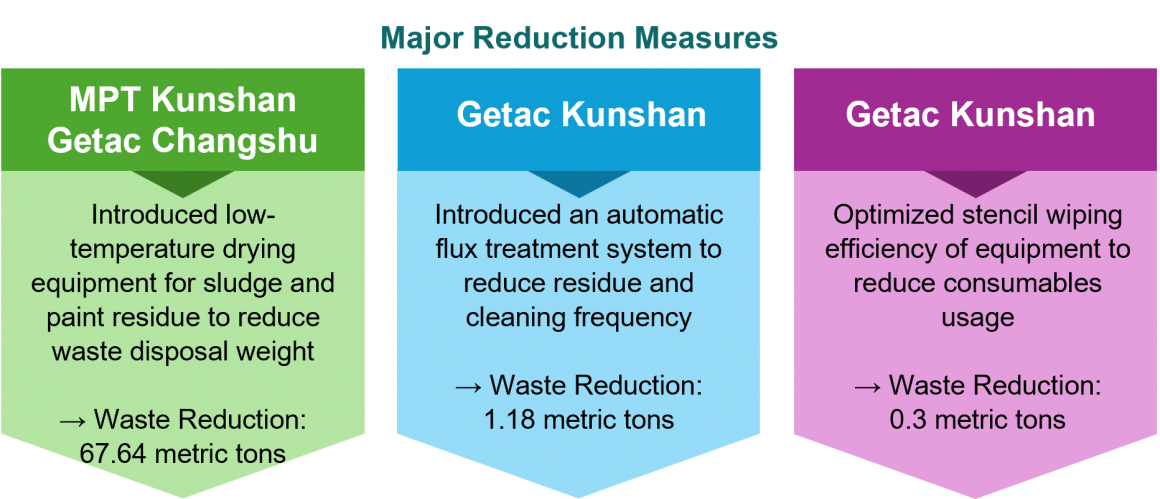
- Implemented 6 hazardous waste reduction projects
- Total waste reduction: 69.12 metric tons (approximately 5.5% of hazardous waste)
- Waste reduction volume approximately doubled compared to 2024, reflecting the continued effectiveness and expansion of waste reduction measures.
Waste Intensity Trend
In 2025, overall waste intensity was 5.391 metric tons per million USD, down from 5.866 metric tons per million USD in 2024. Among which:
- Non-hazardous industrial waste intensity decreased from 4.802 to 4.400
- Hazardous industrial waste intensity decreased from 1.064 to 0.992
This indicates that despite increases in operational scale and production volume, the Company continued to reduce waste generated per unit of output through waste reduction measures and process optimization.
Waste Intensity
| Item | 2023 | 2024 | 2025 | |
| Waste Intensity | Non-hazardous Industrial Waste | 4.106 | 4.802 | 4.400 |
| Hazardous Industrial Waste | 1.559 | 1.064 | 0.992 | |
| Total | 5.665 | 5.866 | 5.391 | |
The Company primarily treats waste through incineration (including with and without energy recovery) and recycling (including preparation for reuse, recycling, and other recovery methods). All waste is disposed of off-site in accordance with applicable regulations. The Company has established comprehensive waste classification and recycling management mechanisms to improve resource recovery efficiency, reduce dependence on natural resources, and optimize waste management processes.
For general waste management, the Company implements waste segregation and promotes waste reduction initiatives at all operating sites, such as encouraging employees to use reusable cups, utensils, and bags, while avoiding the provision of disposable paper cups at meetings to reduce domestic waste generation. Domestic waste is sent to municipal waste treatment facilities for incineration, with some facilities equipped for energy recovery. Waste paper and wooden pallets are reused until no longer serviceable, after which they are recycled by qualified local recyclers.
For general waste generated from operational activities and suppliers, the Company commissions qualified third-party contractors for incineration, recycling, or other lawful disposal methods. Hazardous waste is handled by licensed hazardous waste treatment contractors. Through qualification reviews and waste manifest management systems, the Company ensures that waste transportation and disposal processes comply with regulatory requirements and minimize environmental impacts.
In terms of waste data management, the Company’s China sites have established hazardous industrial waste data collection and monitoring mechanisms. By adopting GPS tracking systems to monitor waste transportation operations and transport routes in real time, and integrating with regulatory authority systems, the Company ensures the integrity and traceability of waste transportation information.
Waste Recycling
In 2025, total waste generation amounted to 6,832.84 metric tons, of which:
- Waste directed to disposal amounted to 1,221.57 metric tons, accounting for 17.88% of total waste.
- Waste diverted from disposal (transferred for treatment) amounted to 5,611.27 metric tons, accounting for 82.12% of total waste.
- Recyclable waste accounted for 83.86% of total non-hazardous waste.
- Recyclable waste accounted for 74.41% of total hazardous waste.
Summary Table of Industrial Waste Generation, Waste Transferred for Disposal, and Direct Disposal
| Item | Category | 2023 | 2024 | 2025 |
| Waste Generation | Hazardous Industrial Waste | 1,741.29 | 1,182.48 | 1,256.82 |
| Non-hazardous Industrial Waste | 4,585.08 | 5,334.87 | 5,576.02 | |
| Total Waste | 6,326.36 | 6,517.34 | 6,832.84 | |
| Waste Transferred for Treatment (Recycling) |
Hazardous Industrial Waste | 1,442.55 | 961.68 | 935.18 |
| Non-hazardous Industrial Waste | 4,152.56 | 4,877.68 | 4,676.09 | |
| Total Waste | 5,595.11 | 5,839.36 | 5,611.27 | |
| Waste directed to disposal | Hazardous Industrial Waste | 298.74 | 220.79 | 321.64 |
| Non-hazardous Industrial Waste | 432.51 | 457.19 | 899.93 | |
| Total Waste | 731.25 | 677.98 | 1,221.57 |
Waste Targets and Indicator Achievement Status
| Item | Short-term Target(2025) | 2025 Performance | Status | 2026 Target |
| Regulatory Compliance | No waste violation incidents | No waste violation incidents occurred throughout the year | ✔️ | No waste violation incidents |
| Waste Reduction Projects | Waste reduction projects accounting for 1% of total annual waste volume | Accounted for 1.01% of total waste volume. Six waste reduction projects reduced waste by 69.12 metric tons, accounting for 5.5% of total hazardous waste volume. | ✔️ | Account for 0.5% of total waste volume |
| Non-hazardous Industrial Waste | Not to exceed 6,103.33 metric tons, representing a 48.94% increase from the base year and a 14.40% increase from the previous year | 5,576.02 metric tons, representing a 31.19% increase from the base year and a 4.52% increase from the previous year | ✔️ | 5,576 metric tons; 31% increase from the base year |
| Hazardous Industrial Waste | Not to exceed 1,461.33 metric tons, representing a 0.82% increase from the base year and a 23.58% increase from the previous year |
|
✔️ | 1,169 metric tons; 19% reduction from the base year |
| Total Waste Volume | Not to exceed 7,564.66 metric tons, representing a 36.37% increase from the base year and a 16.07% increase from the previous year | Total waste volume was 6,832.84 metric tons, representing a 16.20% increase from the base year and a 4.84% increase from the previous year | ✔️ | 6,744 metric tons; 22% reduction from the base year |
| Waste Intensity | 5.866 metric tons per million USD, representing a 14.91% increase from the base year and a 0.34% decrease from the previous year | 5.39 metric tons per million USD, representing a 1.51% decrease from the base year and an 8.09% decrease from the previous year | ✔️ | 5.866 metric tons per million USD |
| Ratio of Waste Transferred for Treatment | Above 85% | 82.12%, with a total of 5,611.27 metric tons recycled | ➖ | Above 85% |




-
We sincerely welcome any suggestions regarding this Report.
Irene Sun
Corporation Relations Office
Email: Getac.csr@getac.com.tw -
Irregular Business Conduct Reporting
Lisa Kung
Director of Auditing Office
Email: gtcaudit@getac.com.tw